Queens Game Online: Free Puzzles Like LinkedIn Queens
Play a Queens game online free: the LinkedIn Queens rules, solving tips that scale to big boards, the eight queens puzzle story, and similar games on Puzzit.
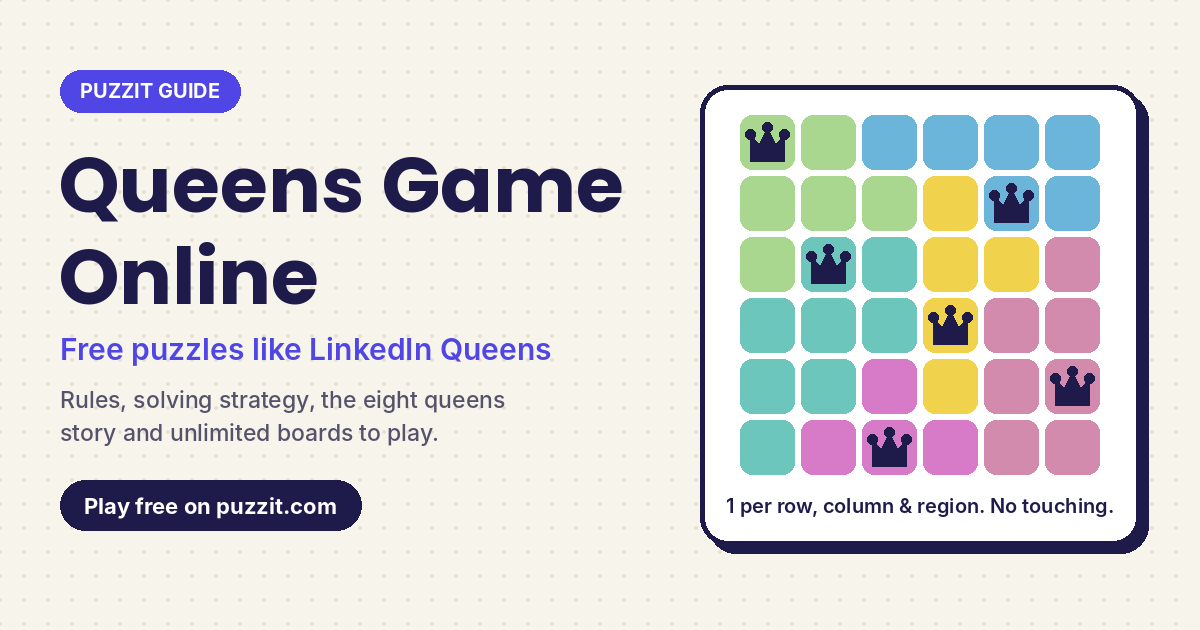
Hooked on the daily crown puzzle and want more than one board a day? You can play a Queens game online for free on Puzzit: Cat Sudoku uses exactly the same rules as LinkedIn Queens, with cats instead of crowns and new levels whenever you want them. This guide explains the rules in plain English, shows the solving techniques that make big boards manageable, clears up how Queens relates to the famous eight queens puzzle, and lists the other free logic games on Puzzit that scratch the same itch. (Puzzit is an independent puzzle site and is not affiliated with LinkedIn.)
What is the Queens game?
Queens is a grid logic puzzle. The board is split into coloured regions, and your job is to place one queen in every row, every column and every region. The one extra rule is what makes it interesting: no two queens may touch, not even diagonally at a corner. An N by N board always needs exactly N queens, so a 7x7 board takes seven and an 8x8 board takes eight.
LinkedIn launched Queens on 1 May 2024 as one of its first three daily games, alongside Pinpoint and Crossclimb, and it quickly became the one people talk about. The catch is that LinkedIn gives you one Queens board per day. That is why searches for an unlimited Queens game keep growing: once the daily board is done, players want to keep going.
- Rows and columns: exactly one queen in each.
- Regions: exactly one queen in each coloured area.
- No touching: a queen blocks all eight cells around it, including the four diagonal neighbours.
- Marks: most versions let you place an X on cells that cannot hold a queen. Using them is the whole game.
Where to play a Queens game online free
On Puzzit the Queens rules live in Cat Sudoku. Instead of crowns you place cats, and the page spells out the same three rules: one cat per colour region, never two in the same row or column, and no diagonal touching. We played it while writing this guide. Normal boards are 6x6 with six cats, Hard boards are 7x7 with seven, and Ultra boards are 8x8 with eight. There is a Cat tool, an X tool for marking blocked cells, a Fill X button for marking cells in bulk, and a hint button for when you are truly stuck.
Because every level comes from its own seed, you can play as many as you like in a row, which makes it a handy unlimited Queens game for practice between daily puzzles. It runs in any browser, on phone or desktop, with no download and no account. If you want the full Cat Sudoku walkthrough, our Cat Sudoku rules and tips guide goes deeper on that game specifically.
How to choose where to play: if you want the shared daily board and the leaderboard among your contacts, that is LinkedIn. If you want more boards, different sizes and no sign-in, a browser version like Cat Sudoku is the better fit. Plenty of players do both, using the unlimited boards as warm-up.
How to solve Queens puzzles: a strategy that scales
Small boards can be brute-forced by trial and error. From 8x8 upward that gets slow and frustrating, so it pays to solve the way setters intend: by elimination. Work through these steps in order and repeat them every time you place a queen.
- Start with the smallest region. A region of one cell is a free queen. A region of two or three cells has very few options, and often every option blocks the same neighbouring cells, so you can X those straight away.
- Look for regions trapped in one row or column. If a region sits entirely inside a single row, its queen must be in that row, so every other cell in that row can be crossed out. The same works for columns.
- Use the squeeze rule. If two regions together fit entirely inside the same two rows, those two rows are used up by those two regions. Every other region loses its cells in those rows. The rule works for any number: three regions confined to three columns claim those three columns.
- Cross out the ring. After each queen, X its row, its column, its region and the eight cells around it. Do it every time, even when it feels obvious.
- Check for a region with one cell left. Elimination usually leaves one region, row or column with a single legal cell. That is your next queen, and the cycle starts again.
One detail that confuses newcomers: the touching rule only covers neighbouring cells. Two queens can sit on the same long diagonal as long as they are not next to each other. That is the main difference from the chess puzzle that gave the game its name.
Another common question is whether a board can have more than one answer. Daily Queens boards are designed to have a single solution, so if you are stuck, a logical next step always exists and guessing is never required. Easy practice boards can be more forgiving. We checked the first Normal board in Cat Sudoku with a short script and found 22 different valid layouts, and the game accepted the one we entered. On beginner boards, any layout that obeys the rules counts, so do not waste time hunting for a single intended answer.
Queens vs the eight queens puzzle vs Star Battle
The name comes from the eight queens puzzle, a chess problem published by the composer Max Bezzel in 1848: place eight chess queens on a standard board so that none can capture another. Franz Nauck published the first full set of solutions in 1850 and extended the problem to any board size, which is why you also see it called the n-queens problem. It has 92 solutions, and only 12 if you count rotations and mirror images as the same; we confirmed both numbers by enumerating every arrangement in code.
The two puzzles look alike but play very differently. Chess queens attack along whole diagonals at any distance, and the eight queens puzzle has no coloured regions. The Queens game drops the long-diagonal rule (only touching is banned) and adds regions, which is what turns it into a deduction puzzle with one answer instead of a search problem with 92.
Its closest relative is Star Battle, a genre created by the Dutch puzzle designer Hans Eendebak for the 2003 World Puzzle Championship in Arnhem. Star Battle uses the same row, column, region and no-touching rules, but usually asks for two stars per row, column and region on a 10x10 grid. A Queens board is essentially the one-star version with colours instead of bold region borders, so if you outgrow Queens, two-star Star Battle is the natural next step. This is a different kind of puzzle from the classic logic riddles people often lump in with it: there is no trick or wordplay, only the grid.
Games like Queens (and other LinkedIn games) on Puzzit
Many players come to Queens through the wider LinkedIn games line-up, which now also includes Tango, Zip and Mini Sudoku. If you are looking for games like LinkedIn games that you can play as often as you like, these Puzzit puzzles cover similar ground:
| If you like | Play on Puzzit | What carries over |
|---|---|---|
| Queens | Cat Sudoku | Identical rules: one per row, column and region, no touching |
| Zip | Zip Dots | Draw one continuous path through numbered dots in order |
| Mini Sudoku | Daily Mini Sudoku | A small daily sudoku with notes, hints and a streak |
| Region logic | Shikaku | Split the grid into rectangles that match each number |
| Deduction under pressure | Daily Minesweeper | Pure elimination from number clues |
| Sudoku with a twist | Emojidoku | Classic sudoku rules played with emojis |
Puzzit does not have a Tango-style binary puzzle yet, so for that one LinkedIn remains the place to play. For the word games in the line-up, such as Pinpoint and Crossclimb, browse the Puzzit word games or our list of games like Wordle. Everything grid-based lives on the free logic puzzles page, including Arrows and Lock Puzzle.
If Queens is your favourite, Shikaku and Minesweeper are the best next stops, because they reward the same habit of crossing out what cannot be true. Our guides to how to play Shikaku and Minesweeper patterns show those techniques step by step.
Queens game online: FAQ
Ready to play?
Pick a board size and start crossing things out.