Minesweeper Patterns: 1-2-1, 1-2-2-1 & Daily Board Tips
Learn the minesweeper patterns that solve most boards: 1-1, 1-2, 1-2-1 and 1-2-2-1, plus first-click odds and tips for the free Puzzit daily minesweeper.
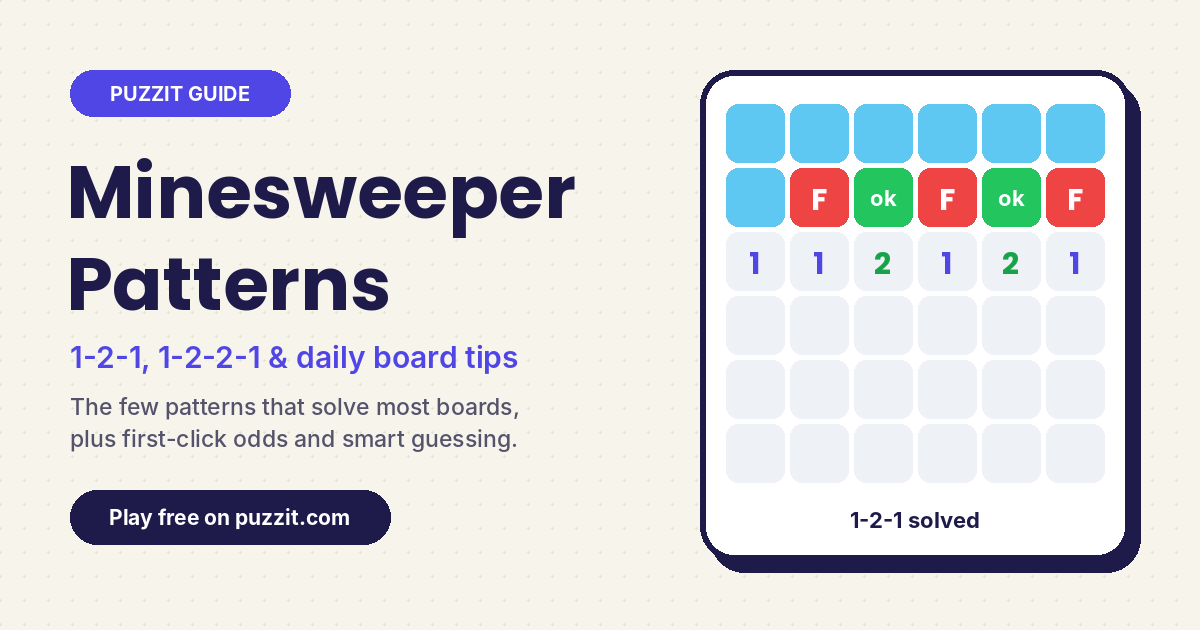
Most people who think Minesweeper is a coin flip have simply never been shown the handful of minesweeper patterns that solve the bulk of every board. Once you can spot a 1-2-1 or a 1-2-2-1 at a glance, you stop guessing and start clearing whole edges in seconds. This guide teaches those patterns with small diagrams, shows how to use them on Puzzit Daily Minesweeper (a free daily board that everyone plays at the same time), and answers the questions most guides skip: where to click first, how to read numbers that do not look like the textbook, and whether the game is really luck.
TODAY'S BOARD
Hard: 12 × 16, 30 mines
162 safe tiles to reveal. Difficulty rotates from day to day.
DAILY MODE
Same board for everyone
A new layout drops at midnight, so times and streaks are directly comparable.
CONTROLS
Click to reveal, right-click to flag
On mobile, tap to reveal and long-press to place or remove a flag.
STATS
Streaks and best times
Played, win %, current and max streak, best and average time, plus a share card.
Minesweeper Rules in 60 Seconds
The board hides a fixed number of mines under blank tiles. Your goal is to reveal every safe tile without ever clicking a mine. Each revealed tile shows a number from 1 to 8: the count of mines in the eight tiles that touch it, including diagonals. A revealed tile with no number (a zero) touches no mines, so the game automatically opens all of its neighbours, which is how big empty areas appear in one click.
Flags are optional notes to yourself. On Daily Minesweeper the footer tracks both: "1/162" means one of 162 safe tiles is open, and "0/30" means you have flagged none of the 30 mines. The timer starts on your first reveal and stops when the last safe tile opens, and you win without flagging anything at all if you prefer.
That is the entire rulebook. Everything else is reading what the numbers force. Two facts carry most of the logic:
- A number equal to its hidden neighbours means they are all mines. A 2 touching exactly two unopened tiles: flag both.
- A number already satisfied by flags means the rest are safe. A 1 that already touches a flagged mine: open every other neighbour.
The 5 Minesweeper Patterns That Solve Most Boards
A pattern is a common arrangement of numbers that has only one possible solution. In the diagrams below the white row is revealed numbers, the row above it is still hidden, red X is a mine, green ok is safe and dark blocks are the board edge. We checked every diagram by enumerating all possible mine placements in code, so each one has exactly the outcome shown.
1. The 1-1 from a wall
The first 1 touches only two hidden tiles, and the second 1 touches those same two plus one more. The mine is in the shared pair, so the third tile from the wall is safe.
2. The 1-2 rule
The 2 needs two mines in its three hidden tiles, but the 1 allows only one in the first two. The tile beyond the 2 must be a mine. Players call this 1-2-X.
3. The 1-2-1
Apply 1-2 from both ends: the tiles above each 1 are mines and the tile above the 2 is safe.
4. The 1-2-2-1
The mirror image: mines sit above the two 2s, and the tiles above the 1s are safe.
5. The corner and "lonely 1". Any 1 (or 2, or 3) that touches exactly that many hidden tiles has no choice, so flag them all. It sounds too simple to count as a pattern, but on a fresh opening it is usually the first move, and corners create it constantly because a corner tile only has three neighbours.
Notice that the 1-2-1 and the 1-2-2-1 are really just the 1-2 rule applied twice, once from each side. If you only memorise two ideas, make them the 1-1 (third tile safe) and the 1-2 (third tile is a mine). They are opposites, and between them they explain most edge situations you will meet.
Why Real Boards Never Look Like the Textbook
The most common complaint from people learning patterns is that they rarely see a clean 1-2-1 in an actual game. They are there, just hidden behind mines you have already found. The trick is called reduction: subtract every flagged (or certainly known) mine from each number that touches it, then read the pattern from what is left.
Worked example: an edge row reads 2-3-2, and you have already flagged a mine directly below the 3, on the opposite side of the row from the unopened tiles. That flagged mine touches all three numbers, so subtract one from each. The row now behaves exactly like a 1-2-1: mines above the outer two, safe tile above the middle. The same idea turns a 2-3-3-2 into a 1-2-2-1 when a flagged mine sits below each of the two outer 2s. If a board feels stuck, go number by number and say the reduced value out loud; a pattern usually appears.
Minesweeper Strategy for the Daily Board
Puzzit Daily Minesweeper gives everyone the same layout, so a good process matters more than speed on the first few tries. Here is the order we use:
- Open in a corner if you want a cascade. On today's 12 × 16 board with 30 mines, a safe corner tile has roughly a 60% chance of being a zero, which opens an area for free, against about 42% on an edge and about 25% in the middle (assuming random mine placement; we computed these with exact combinations). Our own test click in the centre showed a lone 1 and nothing else, which is the typical middle-of-board result.
- Clear the obvious first. Sweep the whole opening for lonely numbers and satisfied numbers before thinking hard about anything. Each easy move adds information for the hard ones.
- Work along the frontier, then the edges. Patterns live where revealed numbers meet hidden tiles. Board edges act like walls, which is exactly where the 1-1 and 1-2 rules apply.
- Flag only when it helps. Flags are useful for reduction, but flagging every mine costs time. Many fast players flag only mines that touch numbers they still need to read.
- Use the mine count late in the game. With few tiles left, the remaining mine total can settle a position that local numbers cannot. If 2 mines remain and only one arrangement of the last pocket fits, you know every tile.
- Keep your streak alive. A slow, correct clear beats a fast loss. The stats panel tracks your current and best streak, so careful play pays off over a week.
Is Minesweeper Luck or Skill?
Mostly skill. The large majority of tiles on a typical board can be solved with the patterns and reduction above. Luck does exist: some positions leave two tiles that are perfectly symmetrical, a true 50/50 that no logic can break, and Wikipedia's entry on Microsoft Minesweeper notes that some mines require guessing, usually with a 50-50 chance. Mathematician Richard Kaye even proved in 2000 that the general problem of deciding whether a Minesweeper position is consistent is NP-complete, which is a formal way of saying some positions are genuinely hard rather than just unfamiliar.
When you are forced to guess, guess smart. Take the guess early rather than after an hour of work, prefer the tile that will reveal the most new information if it is safe, and avoid tiles squeezed between high numbers. On a daily board there is a bonus: everybody faces the same forced guess, so comparing results with friends is still fair.
Daily Minesweeper vs Classic Windows Minesweeper
The Minesweeper most people grew up with was created by Curt Johnson and ported to Windows by Robert Donner. It first shipped in Microsoft Entertainment Pack 1 in 1990 and became part of the standard Windows 3.1 install in 1992. Its classic Expert board is 30 × 16 with 99 mines. Here is how a daily board compares:
| Puzzit Daily Minesweeper | Classic Windows Minesweeper | |
|---|---|---|
| Board | Rotates daily (today Hard: 12 × 16, 30 mines) | Beginner, Intermediate, Expert or custom |
| Mine density | 15.6% on Hard, the same as classic Intermediate (40 mines on 16 × 16) | 12.3% Beginner (9 × 9), 15.6% Intermediate, 20.6% Expert |
| New puzzle | One board per day, identical for every player | Unlimited random boards |
| Platform | Any browser, phone or desktop, free | Bundled with older Windows; now a Microsoft Store app |
| Tracking | Streaks, win %, best and average time, share card | Best times per difficulty |
The portrait 12 × 16 shape also suits phones far better than a wide 30-column Expert board, and long-press flagging means you can play comfortably one-handed.
More Logic Puzzles If You Like Minesweeper
Minesweeper is a deduction game wearing a bomb costume, and the same "what must be true here?" thinking powers several other Puzzit games. Meowdoku asks you to place cats so each row, column and region holds exactly one, much like the LinkedIn Queens game; our cat sudoku rules and tips guide covers its own patterns. Shikaku splits a grid into rectangles from area clues, Sudoku and Emojidoku are pure elimination, and Lock Puzzle has you crack a code from feedback clues.
For a wider list, see our math and logic puzzles roundup, the best puzzle games guide and our brain teaser puzzles collection.
Frequently Asked Questions
What do the numbers mean in Minesweeper?
Each number counts the mines in the eight tiles touching it, including diagonals, so it can range from 1 to 8. A blank revealed tile is a zero, which is why the game opens its neighbours automatically.
What is the 1-2-1 pattern in Minesweeper?
When a row of revealed numbers reads 1-2-1 against hidden tiles, the tiles directly beside each 1 are mines and the tile beside the 2 is safe. It is the 1-2 rule applied from both ends. The 1-2-2-1 is its mirror: mines beside the 2s.
What is the 1-2 rule in Minesweeper?
Along a straight frontier, if a 1 is followed by a 2, the hidden tile just past the 2 must be a mine. The 2 needs two mines in its three tiles, and the 1 allows only one of them in the first two.
Is Minesweeper based on luck?
Mostly no. Most tiles can be solved with logic, but some positions leave a true 50/50 that requires a guess. Good players reduce those situations to a minimum and guess early when they must.
Where should you click first in Minesweeper?
A corner gives the best chance of an opening cascade because a corner tile has only three neighbours. On a 12 × 16 board with 30 mines, a safe corner is a zero about 60% of the time, compared with about 25% for a middle tile.
Is there a free daily Minesweeper online?
Yes. Puzzit Daily Minesweeper is free in the browser with no download or account. Everyone gets the same board each day, difficulty rotates, and a new board drops at midnight.