Shikaku Game: How to Play, Rules & Daily Puzzle Tips
Learn the Shikaku game: the rules, a step-by-step 5×5 solve, prime-number tips and the Shikaku of the day. Play 2,500 free levels on Puzzit, no download.
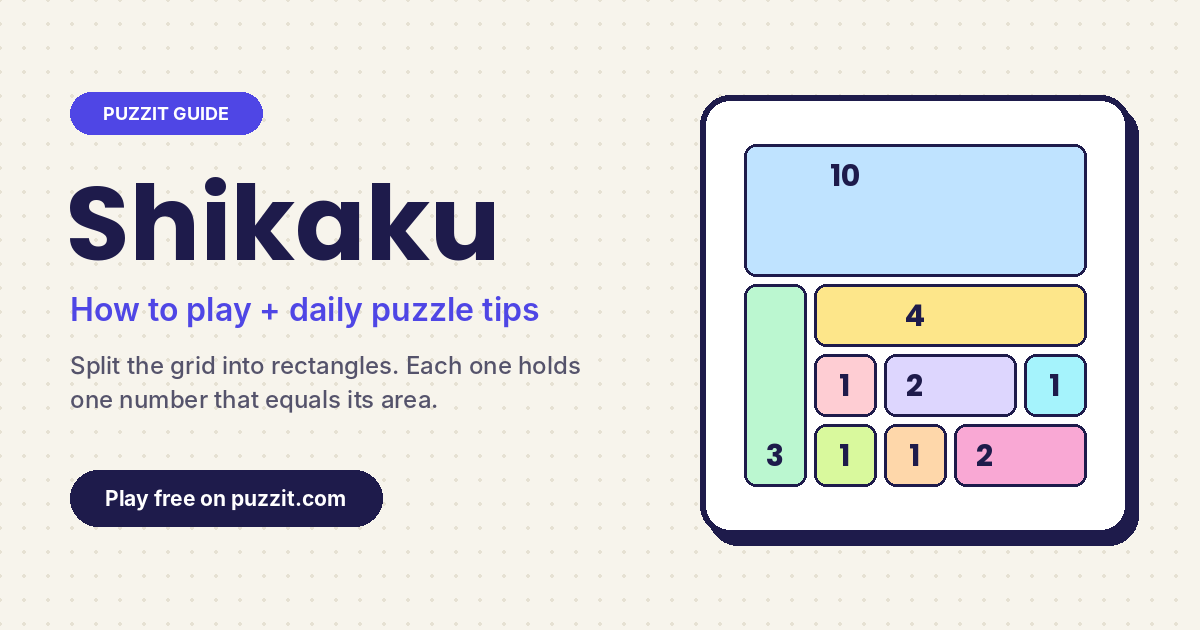
The Shikaku game hands you a grid with a few numbers on it and one job: split the whole board into rectangles. Every rectangle holds exactly one number, and that number tells you how many squares the rectangle covers. That is the entire rulebook, and it is enough to keep you thinking for hundreds of levels. You can play Shikaku free on Puzzit in any browser with no download, either working through the numbered levels or taking on the daily puzzle. This guide covers the rules, how the Puzzit controls work, a full worked example, and the tips that make bigger grids feel manageable.
ORIGIN
Japan, 1989
Invented by Yoshinao Anpuku and published by the puzzle magazine Nikoli.
THE GOAL
Divide the grid
Cover every cell with rectangles. One number per rectangle, number = area.
ON PUZZIT
2,500 levels + daily
Levels start at 4×5. The daily puzzle is a fresh board every day.
COST
Free, no sign-up
Runs in the browser on desktop, phone and tablet.
What Is the Shikaku Game?
Shikaku is a pencil-and-paper logic puzzle from Japan. It was created in 1989 by Yoshinao Anpuku and popularised by Nikoli, the same publisher that made Sudoku famous. Outside Japan you will also see it called Rectangles or Divide by Box; the full Japanese title, Shikaku ni Kire, roughly means “divide into squares”.
On the Shikaku meaning question: the Japanese word shikaku (四角) means a square or four-cornered shape, which is exactly what you draw all game. If you searched the word and landed somewhere unexpected, that is because it is also the name of a character in Naruto and the title of a Tatsuki Fujimoto short story adapted in the 17-26 anime anthology. This page is only about the puzzle.
If you enjoy number-based deduction like Sudoku or our cat-themed Meowdoku, Shikaku will feel familiar in spirit but different in practice: you never write digits, you draw shapes.
How to Play Shikaku: The Rules
Four rules, and every one of them matters:
- Each number is an area. A 6 needs a rectangle of exactly six cells: 1×6, 2×3, 3×2 or 6×1.
- One number per rectangle. A rectangle cannot contain two clues, and it cannot be empty of clues.
- No overlaps. Each cell belongs to exactly one rectangle.
- No gaps. When you finish, every cell on the board is covered. Squares count as rectangles; L-shapes do not.
Two details beginners often miss: the number can sit anywhere inside its rectangle, not just in a corner, and a bigger rectangle is not “better”. There is no scoring for shape, only for a correct split.
How to Play Shikaku on Puzzit
Open Shikaku on Puzzit and you will see two tabs at the top: Levels and Daily. To draw a rectangle, press on one corner cell and drag to the opposite corner, then release. If the box is valid it fills with a colour; when every cell is coloured correctly, a Level Complete card appears and you can jump straight to the next level.
The game also checks each box the moment you let go, which is a handy teacher. In our playtest, a box that was too big was rejected with “This rectangle must cover 2 cells”, and a box with no clue inside was rejected with “Each rectangle must contain exactly one number”. So you can never place a wrong-sized rectangle; the only mistakes possible are rectangles that are the right size but in the wrong place. If you paint yourself into a corner, Reset Level clears the board, and the Stats button shows how many levels you have solved and your best level so far.
Worked Example: Solving a 5×5 Shikaku Step by Step
Here is Level 3 from Puzzit Shikaku. Rows are counted from the top and columns from the left. Before touching anything, add up the clues: 10 + 4 + 2 + 2 + 3 + 1 + 1 + 1 + 1 = 25, which matches the 25 cells of a 5×5 grid. That check is worth doing on every board; it confirms you have read every clue.
Level 3: nine clues, 25 cells.
- Lock in the 1s. Each 1 is a one-cell rectangle on its own square. There are four of them.
- The 3 in the bottom-left corner cannot go right, because the 1 next to it is already finished. The only fit is straight up the first column, rows 3 to 5.
- The bottom-right corner cell can only be reached by the 2 beside it (the cell above it is a finished 1), so that 2 covers the last two cells of the bottom row.
- The 2 in row 4 is boxed in by clues on three sides, so it must take the empty cell to its right.
After step 4: the bottom of the board is solved.
- Now the 10. Ten cells means 1×10 (too long for this board) or 2×5. The only 2×5 that contains the 10 and no other clue is the whole top two rows.
- The 4 finishes it. The cells left over are row 3, columns 2 to 5: exactly four cells in a line around the 4. Done.
Solved. Every cell is covered once, and each rectangle holds one clue that matches its size.
Notice the pattern: corners and boxed-in clues went first, and the biggest number was solved by eliminating its shapes, not by trial and error. That is the whole method in miniature.
Shikaku Strategy: 7 Tips for Bigger Grids
- Start where the walls are. Corner and edge cells have the fewest neighbours, so the clues that can reach them are easy to pin down.
- Love the prime numbers. A 5, 7, 11 or 13 has only two possible shapes: a straight line across or down. If one direction is blocked, the clue is solved.
- Ask “who can reach this cell?” Pick an empty cell and list the clues that could cover it. When only one can, that clue owns the cell, which often fixes its whole rectangle.
- Know your factor pairs. The more ways a number factors, the later you should place it. See the table below.
- Big numbers can be easier than they look. In the example, the 10 had one legal position. Large clues are often squeezed by the board edges and neighbouring clues.
- Count closed areas. If a group of empty cells is sealed off, the clues that can reach it must add up to its size. A mismatch means a rectangle nearby is wrong.
- Do the sum check first. The clues always add up to rows × columns. If your total is off, you misread a number.
| Clue | Possible shapes (rows × columns) | How flexible |
|---|---|---|
| 2, 3, 5, 7 | 1×n or n×1 only | Very low: a straight line |
| 4 | 1×4, 2×2, 4×1 | Low |
| 9 | 1×9, 3×3, 9×1 | Low: usually the 3×3 square |
| 6, 8, 10, 15 | 4 shapes each (e.g. 2×3, 3×2) | Medium |
| 12, 16 | 6 and 5 shapes | High: place these last |
One more thing worth knowing if you have read elsewhere that every Shikaku has exactly one answer: that is true of hand-made puzzles from magazines like Nikoli, but not of every Puzzit board. We ran Level 2 through a small solver and found six valid ways to split it, and the layout we drew was accepted. So if you reach a fork where two placements both seem to work and nothing rules either out, pick one and keep going; as long as the finished board obeys all four rules, you are fine.
Shikaku of the Day: Daily Puzzle vs Levels
Searching for a Shikaku of the day? Puzzit has one built in. Switch to the Daily tab and you get a board stamped with today’s date, the same puzzle for everyone. On the day we wrote this it was a 6×7 grid with 16 rectangles, a step up from the early levels. The Levels tab is the practice track: it starts with small 4×5 boards and grows from there, and it remembers where you left off.
A good routine is to warm up with a level or two, then take on the daily Shikaku puzzle while your eye for corners and primes is fresh.
Shikaku vs Sudoku and Other Logic Puzzles
| Puzzle | What you do | Try it on Puzzit |
|---|---|---|
| Shikaku | Split the grid into rectangles sized by the clues | Shikaku |
| Sudoku | Place 1–9 with no repeats in rows, columns, boxes | Sudoku, Mini Sudoku |
| Minesweeper | Use number clues to find hidden mines | Daily Minesweeper |
| Meowdoku | One cat per row, column and colour region, no diagonal touching | Meowdoku |
| Zip Dots | Connect numbered dots in continuous paths | Zip Dots |
Shikaku sits closest to Minesweeper in feel: both turn small numbers into spatial deductions. If you like that, our guide to Minesweeper patterns uses the same “what can reach this cell?” thinking, and the Meowdoku rules and tips post covers another region-based grid puzzle. For something with arithmetic in it, try the math crossword puzzle. You can browse every deduction game on the logic puzzles page.
Shikaku Game FAQ
Is Shikaku hard?
The rules take a minute to learn and small boards are gentle. Difficulty comes from size: on larger grids, clues like 12 or 16 have many possible shapes, so you have to work from the corners and primes inward.
Do you have to guess in Shikaku?
In a puzzle designed to have one solution, no; every placement can be forced by logic. On Puzzit some boards have more than one valid split, so if two options both obey the rules, either one can lead to a finished board.
What does Shikaku mean?
Shikaku (四角) is Japanese for a square or four-cornered shape. The puzzle is also known as Rectangles or Divide by Box.
Is there a Shikaku solver?
Solver tools exist online, but you rarely need one. Use the sum check, solve the 1s and primes, then ask which clue can reach each empty cell. On Puzzit, Reset Level gives you a clean board to try again.
Can the number be anywhere inside the rectangle?
Yes. The clue can sit in a corner, on an edge or in the middle of its rectangle. Only the area has to match.
Where can I play the Shikaku game free online?
Puzzit Shikaku is free with no account or download. It has 2,500 levels plus a daily puzzle and works on desktop, phones and tablets.
Play Shikaku Now
Shikaku rewards the same habit every time: read the clues, start at the edges, and let the board tell you where each rectangle must go. Open Shikaku on Puzzit, try today’s daily, and see how far up the levels you can climb.