Tricky Riddles with Answers: 22 Brain Twisters Explained
Tricky riddles with answers, sorted by the trap they set: double meanings, false premises and math tricks, plus a simple checklist to solve any riddle.
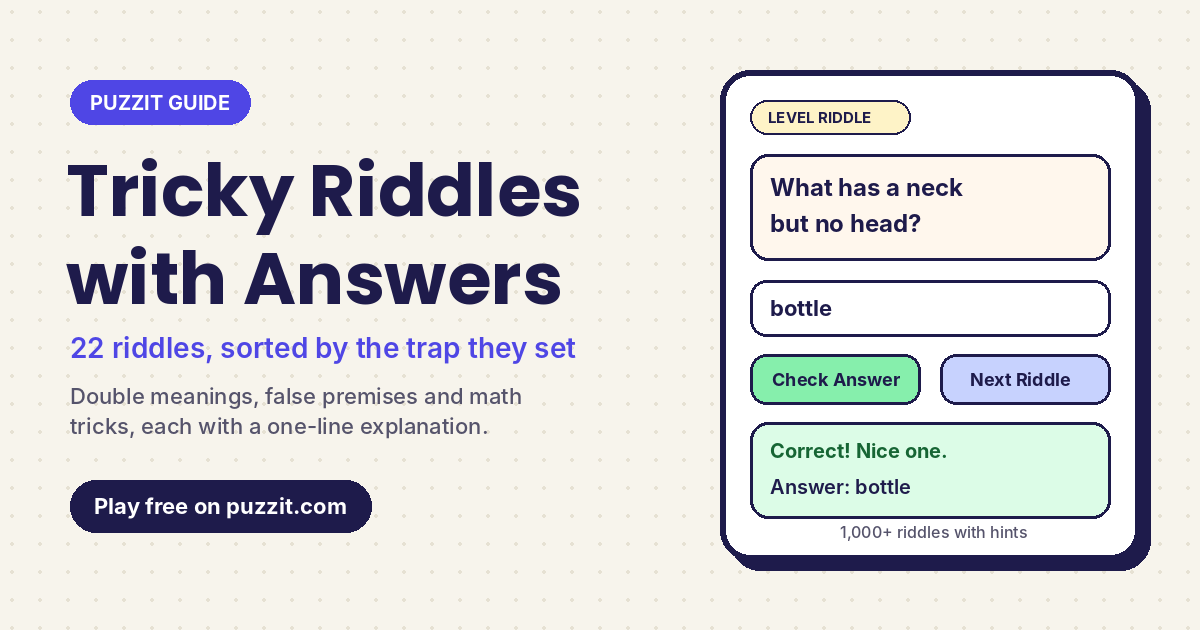
Good tricky riddles with answers feel unfair for about ten seconds, then completely obvious. The trick is never hidden in hard knowledge: it sits in a word with two meanings, a fact you were told to accept, or a number that is doing something other than what you assumed. Below are 22 of our favourite tricky riddles, sorted by the kind of trap they set, with the answer and a one-line explanation for each. When you are done, the Puzzit Riddles game has more than 1,000 more, plus a free Riddle of the Day.
Why tricky riddles fool smart people
A tricky riddle works because your brain reads for meaning, not for exact words. You see "hands" and picture a person, you see "a plane crash" and jump to the sad part, you see a sum and start calculating. Almost every tricky riddle uses one of four traps, and once you can name the trap you can usually spring it:
- Double meaning: a word like neck, eye or sentence means something different from the first picture in your head.
- False premise: the question states something untrue, and the answer is simply pointing that out.
- Literal reading: the question means exactly what it says, and the trap is overthinking it.
- Number misdirection: the arithmetic looks like the puzzle, but the real puzzle is what is being counted.
Tricky riddles with double meanings
These are the classic "what am I?" riddles. Read each noun and verb slowly and ask what else it could mean.
Riddles that hide a false premise
People often complain that these are "cheating" because the riddle tells you something and then blames you for believing it. They are fair as long as the false part is a claim you could have questioned using everyday knowledge. If the only way to solve it is to know a private fact the riddle-writer made up, it is a bad riddle, not a tricky one.
Riddles with simple answers you overthink
These are the best easy riddles to start a group with, because the answer is so plain that people talk themselves out of it.
Tricky math riddles with answers
Math riddles look like sums, so your brain starts calculating before it has read the question properly. Slow down and ask what is actually being counted. We checked each answer below with a quick calculation. If you like this style, Calculator: The Game and Mathle are built on the same "read the rules before you compute" habit.
How to solve any tricky riddle: a 4-question checklist
Most riddle lists stop at the answers. If you actually want to get faster at them, run through these four questions every time, in this order:
- Which word could mean something else? Circle nouns like hands, keys, bark, sentence, branches. Most "what am I" riddles hinge on one of them.
- Is anything in the question untrue? Roosters, survivors, Moses. If a detail sounds slightly off, it probably is the whole riddle.
- What exactly is being asked? "Which month has 28 days" is not "which month has only 28 days". Reread the last sentence word by word.
- What is being counted? In number riddles, check whether the people, the objects or the steps are the real unknown.
Riddles also lean heavily on English wordplay, so they can feel unfair if English is not your first language or if a riddle depends on one country's trivia. Homophones and idioms are the usual culprits: sentence (words or prison), bark (tree or dog), catch (a ball or a cold). If a riddle seems impossible, try saying the key word out loud and listing its other meanings. That habit also helps with rebus puzzles, which turn sounds into pictures.
Playing tricky riddles on Puzzit
The Riddles game on Puzzit turns these into a game you can play a few at a time. Each riddle appears in a card, you type your guess and press Check Answer. If you are stuck, Show Hint gives a short clue (for the "keys but no locks" riddle it reads "It's used for typing"), and Reveal Answer shows the solution so you can move to the next one. Your progress through the full list is saved in your browser, and the counter at the top shows how many you have solved.
One practical tip from playing it: type the bare answer word. When we tested "What gets wetter as it dries?", "towel" was accepted straight away, while "a towel" was marked wrong. Leave out "a", "an" and "the", and use the most common word for the thing (a clock rather than a wall clock).
Above the main game is the Riddle of the Day, a single riddle that is the same for everyone that day and changes daily. It is a nice warm-up, and a good one to send to friends because you will all be solving the same question.
What if your answer is different but also fits?
This happens more than riddle sites admit. "What can you catch but not throw?" is usually answered "a cold", but "a glimpse" or "your breath" also work. A good riddle has one answer that fits every line best, so when two answers fit, check which one explains every clue, not just the first. In the Puzzit game the checker compares your guess with one stored answer, so if you are confident and it is rejected, try the most common synonym, then use the hint to see which direction the riddle-writer meant. When you play with friends, any answer that honestly fits every line deserves the point.
Tricky riddles vs hard riddles vs brain teasers
These words get mixed up a lot. Tricky riddles are short and rely on misdirection, so they are perfect for a car ride or a group chat. Hard riddles are longer and stack several clues, like the poems in our guide to the hardest riddle in the world. Brain teasers are a wider family that includes logic and visual puzzles; see our brain teaser puzzles round-up. If you want something visual, Emoji Guess and Rebus Puzzles hide words in pictures, and Chain It rewards the same "what else could this word mean" thinking with compound words.
Tricky riddles FAQ
Ready for a few more?
Try the Riddle of the Day, then see how far you can get through the full list without revealing an answer.