Squaredle Hints & Tips: Find Every Word Faster
Squaredle hints that work: start from rare letters, grow word stems, sweep for suffixes and rotate the grid. Practise free on Puzzit's daily GridWord.
These Squaredle hints are the habits that turn a stare-at-the-grid session into a steady run of finds. Squaredle is the daily word puzzle where you swipe through neighbouring letters to spell hidden words, and once you know where words like to hide, you stop needing a solver. Every tip below was tested on GridWord, Puzzit's free daily Squaredle-style puzzle, so you can try each one on today's board as you read.
What is Squaredle?
Squaredle is a daily word-search puzzle created by software engineer Michael Giuffrida and launched on March 5, 2022, riding the same wave of daily web games that Wordle started. You build words by dragging across letters that touch each other horizontally, vertically or diagonally, much like the classic dice game Boggle. Each puzzle has a set of required words plus extra "bonus" words that count for bragging rights but are not needed to finish.
The official game checks words against the North American Scrabble Players word list (NWL2023), so proper nouns, abbreviations and hyphenated words do not count. Its FAQ also explains a detail that confuses new players: squares fade out once they are no longer part of any required word you still need. The idea has spread widely, which is why so many people search for Squaredle free, Squaredle unlimited and Squaredle online versions to play between daily puzzles.
How to play GridWord, the Squaredle puzzle on Puzzit
GridWord keeps the core Squaredle idea but trims it into a focused daily puzzle. Instead of dozens of required words, you hunt a short list of hidden words in a 5x5 grid. On the day we played there were five: four 7-letter words and one 5-letter word.
- Look at the Words to find panel. Each slot shows one dot per letter, so you know the exact lengths you are hunting before you touch the grid.
- Press on a letter and swipe through neighbouring tiles in any of the eight directions. A tile can only be used once inside the same word.
- Let go to submit. A correct word drops into its slot with a tick, and the tiles you used dim so the untouched letters stand out.
- Tap Shuffle to turn the board a quarter-turn. Every letter keeps the same neighbours, so all the answers are still there, just seen from a new angle.
- Stuck for good? Reveal Word fills in a word for you. Your progress is saved, so you can close the tab and come back later the same day.
Squaredle hints that actually work
Most guides stop at "look for common words". These are the specific moves strong players use, in the order worth trying them.
Worked example: one path, four words
Here is a practice grid we built to show tip 3 in action. It is not a real daily puzzle, so there is nothing to spoil.
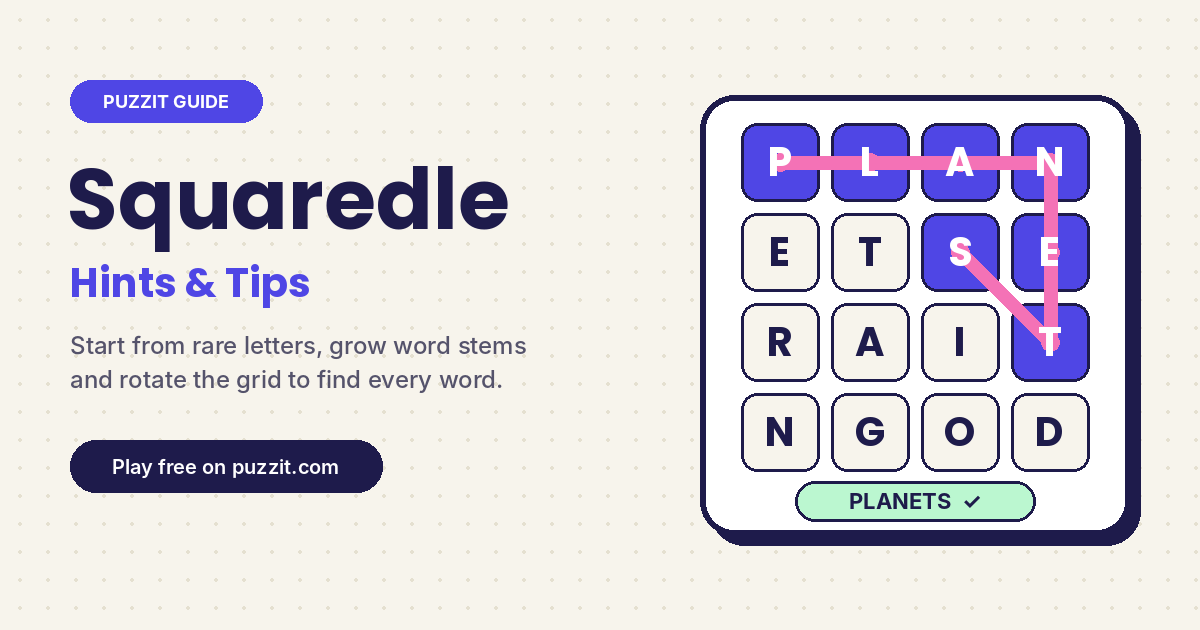
Start in the top-left corner and read straight across: PLAN. Now look for a tile that touches the N. The E directly below it gives PLANE. The T under that E gives PLANET, and the S diagonally up-left of the T, which you have not used yet, gives PLANETS. That is four words from a single swipe, and a seven-letter answer that most players would never spot by scanning for long words directly.
The same grid shows the suffix sweep. The ER pair on the left edge (E above R) finishes TOASTER, which starts at the T on the right edge and snakes back across the board, and STAR grows into STARE by stepping from the R back up to the E. We checked every path in this example with a script, so you can trace them yourself.
Squaredle solver vs solving it yourself
Squaredle solver is one of the most searched phrases around the game, and solvers do work: they test every path in the grid against a dictionary. The trouble is that they dump everything at once, including obscure bonus words, and the puzzle is over the moment you look. A better approach is a hint ladder: first check the length of the missing word, then its first letter, then the tile it starts on. Each step leaves you something to find.
In GridWord the length is always visible, and Reveal Word is there as the final rung. If you want more practice without spoilers, Word Search trains the same scanning skill, and our guide to LinkedIn games covers Wend, LinkedIn's own letter-path puzzle.
Squaredle unlimited and free alternatives
The official Squaredle gives you a daily puzzle, a quick Express puzzle and a harder Weekly one; the archive of past puzzles is a perk of its paid Squaredle Squared membership. If you just want more letter grids to swipe, here is how the main options compare.
| Game | Grid | What you find | Best for |
|---|---|---|---|
| Squaredle (official) | Varies by puzzle | Every required word, plus bonus words | Completionists who want leaderboards |
| GridWord on Puzzit | 5x5 | A short list of hidden words, lengths shown | A free daily puzzle you can finish in one coffee |
| Boggle | 4x4 dice (classic) | As many words as you can before the timer runs out | Playing against friends at the table |
| NYT Strands | 6x8 | Theme words that use every letter | Fans of themed puzzles |
| Word Search on Puzzit | Fixed list | Words in straight lines | Warming up your scanning eye |
If your daily routine already includes Wordle, Squaredle-style puzzles are a nice change of pace because they reward spotting rather than deduction. For more ideas, see our list of games like Wordle, or try Chain It and our word chain game examples if you enjoy building words from pieces.
Squaredle hints: FAQ
Ready to find every word?
Open today's board, try the corner and suffix tricks, and see how many words you can find before you reach for Reveal.