Mini Sudoku Game: How to Play 5x5 & Solve Fast
Learn how to play the mini sudoku game: 5x5 rules, why there are no boxes, a worked example, speed tips, and how it compares with LinkedIn's 6x6 version.
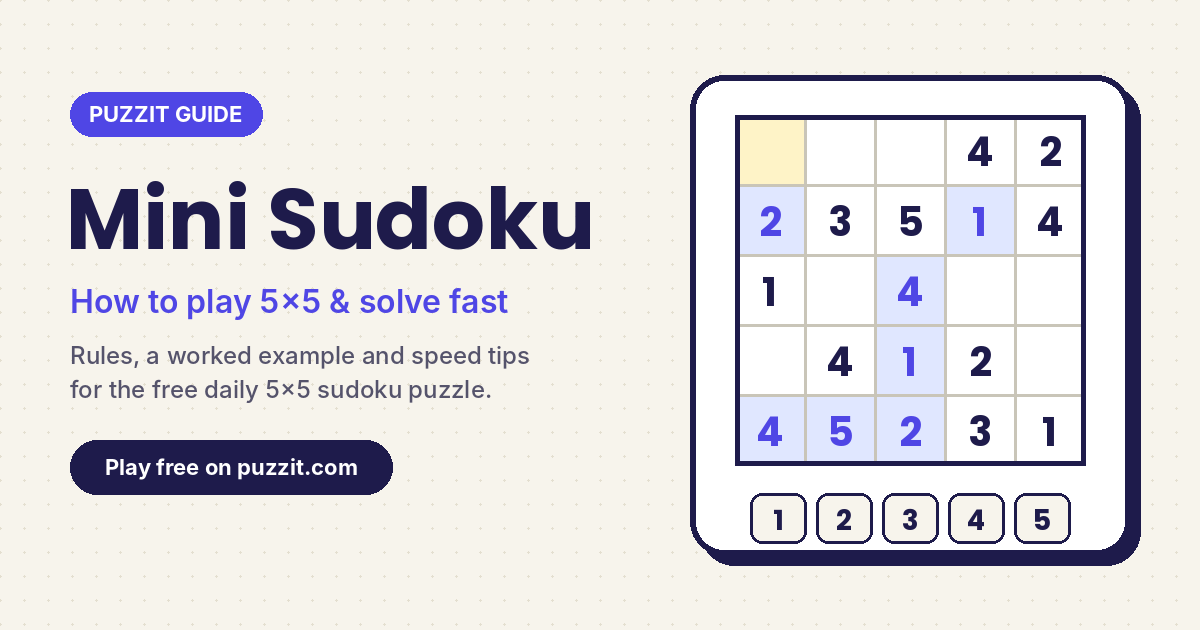
A mini sudoku game gives you the same "every number once" logic as classic Sudoku, squeezed into a grid you can finish over a cup of tea. On Puzzit, Daily Mini Sudoku is a 5x5 puzzle that uses only the numbers 1 to 5, and a fresh board appears every day. This guide explains how to play mini sudoku, why a 5x5 grid has no boxes, a fully worked example you can follow cell by cell, and the habits that cut your solve time down to a minute or two.
What is a mini sudoku game?
"Mini sudoku" is a family name rather than one fixed format. Most versions shrink the classic 9x9 grid to 4x4, 5x5 or 6x6 so that a puzzle takes minutes instead of half an hour. The rule never changes: no number may repeat in a line. What changes is the grid size, the range of digits and whether the grid is split into boxes.
Puzzit's version is a 5x5 sudoku. You fill 25 cells with the numbers 1 to 5 so that every row and every column contains each number exactly once. A few numbers are given at the start, the rest is pure deduction. There is no arithmetic involved, which is why mini sudoku works as well for kids learning logic as it does for adults who want a quick daily warm-up before the full 9x9 Sudoku.
Why a 5x5 sudoku has no boxes
Players coming from 6x6 or 9x9 puzzles often look for the thick box borders and do not find any. That is not a missing feature. Boxes in Sudoku are rectangles that tile the grid evenly: 9 splits into 3x3, 6 into 2x3, 4 into 2x2. Five is a prime number, so there is no way to cut a 5x5 grid into five equal rectangles of five cells. Some puzzle books get around this with odd-shaped "jigsaw" regions; Puzzit keeps it clean with rows and columns only.
In maths terms, a finished 5x5 board is a Latin square, a grid where every symbol appears once per row and column. Leonhard Euler studied these squares in the 18th century, long before Sudoku existed. There are 161,280 different ways to fill a 5x5 Latin square (we checked that count with a quick program), so the daily puzzle has plenty of room to stay fresh.
How to play mini sudoku on Puzzit
- Open the daily mini sudoku. The date and your time zone are shown above the grid, and the timer starts right away.
- Click or tap an empty cell. Its row and column light up so you can scan them at a glance.
- Enter a number with the 1 to 5 buttons or your keyboard. Every copy of that number on the board is outlined, which makes clashes easy to spot.
- Press N (or the Notes button) to switch to pencil marks for cells where you are not sure yet. Use the eraser key to clear a cell.
- Stuck? Press H for a hint. The hint counter shows how many you have used, which is handy if you want to track "no-hint" solves.
- Use Check progress to test your entries, or Reset to start the board again. Your wins, average time, streak and best streak live in the Stats panel.
One detail most guides skip: Puzzit's daily puzzle rolls over at midnight on your device's date, not at a fixed global time. If you travel, the Stats panel shows which time zone it is using, so your streak follows your calendar rather than someone else's.
Worked example: solving a 5x5 mini sudoku without guessing
A well-made mini sudoku has exactly one solution, and you never need to guess to find it. Here is a practice puzzle we built for this guide (it is not today's board, so no spoilers). It has 10 givens and a single solution, which we verified by computer.
| 4 | 2 | |||
| 3 | 5 | 4 | ||
| 1 | ||||
| 4 | 2 | |||
| 3 | 1 |
| 4 | 2 | |||
| 2 | 3 | 5 | 1 | 4 |
| 1 | 4 | |||
| 4 | 1 | 2 | ||
| 4 | 5 | 2 | 3 | 1 |
From here every remaining cell falls the same way, either because a row or column has one gap left, or because a number has only one legal spot in its line. The shaded cells above are the seven we just placed. The finished grid looks like this:
| 5 | 1 | 3 | 4 | 2 |
| 2 | 3 | 5 | 1 | 4 |
| 1 | 2 | 4 | 5 | 3 |
| 3 | 4 | 1 | 2 | 5 |
| 4 | 5 | 2 | 3 | 1 |
Notice that we never wrote a single "maybe". The two moves above, last gap in a line and only spot for a number, solve the large majority of 5x5 boards on their own.
Mini sudoku tips to solve faster
- Start with the busiest lines. A row or column with three or four givens is the quickest win. Fill it, then scan the lines that cross it.
- Count each number. Every digit appears exactly five times in a finished grid. If the 3 already appears four times, the fifth 3 sits in the only row and column without one.
- Scan by number, not by cell. Pick a digit and ask where it can go in each row. This "hidden single" hunt is faster than checking every cell's candidates.
- Use notes only for pairs. On a 5x5 board you rarely need full pencil marks. Note a cell when it is down to two options; when one of the pair gets placed elsewhere, the other is confirmed.
- Check both directions after each move. A number you place removes options from its row and its column. Beginners often look one way and miss the free cell in the other.
- Save hints for real dead ends. If you feel stuck, count digits first. The answer is usually a number with four copies already on the board.
Puzzit Mini Sudoku vs LinkedIn Mini Sudoku and 6x6 sudoku
LinkedIn added Mini Sudoku to its daily games in August 2025, made with the Japanese puzzle publisher Nikoli. Its board is a 6x6 sudoku with six 2x3 boxes and the digits 1 to 6. The skills carry over directly between the two, but the puzzles are not the same. If you enjoy LinkedIn's lineup, our LinkedIn games guide maps each one to a free Puzzit alternative.
| Feature | Puzzit Mini Sudoku | LinkedIn Mini Sudoku | Classic Sudoku |
|---|---|---|---|
| Grid | 5x5 | 6x6 | 9x9 |
| Digits | 1 to 5 | 1 to 6 | 1 to 9 |
| Boxes | None (rows and columns only) | Six 2x3 boxes | Nine 3x3 boxes |
| Rough solve time | 1 to 3 minutes | 2 to 5 minutes | 10 to 30+ minutes |
| Account needed | No | LinkedIn login | Depends on site |
Want more grid logic after your daily board? Meowdoku swaps digits for cats (see our cat sudoku tips), Emojidoku does the same with emojis, and Shikaku asks you to split a grid into rectangles. For a number-first challenge, Cross Math turns the grid into equations. You will find all of them on the number games hub.
Mini sudoku FAQ
Ready for today's board?
Open the daily puzzle, start with the fullest row, and see if you can finish without a single hint.