2048 Strategy: How to Win 2048 (Tested Tips)
The best 2048 strategy, step by step: the corner and snake method, the next-tile habit our computer test proved, and how to win 2048 more often. Play free.
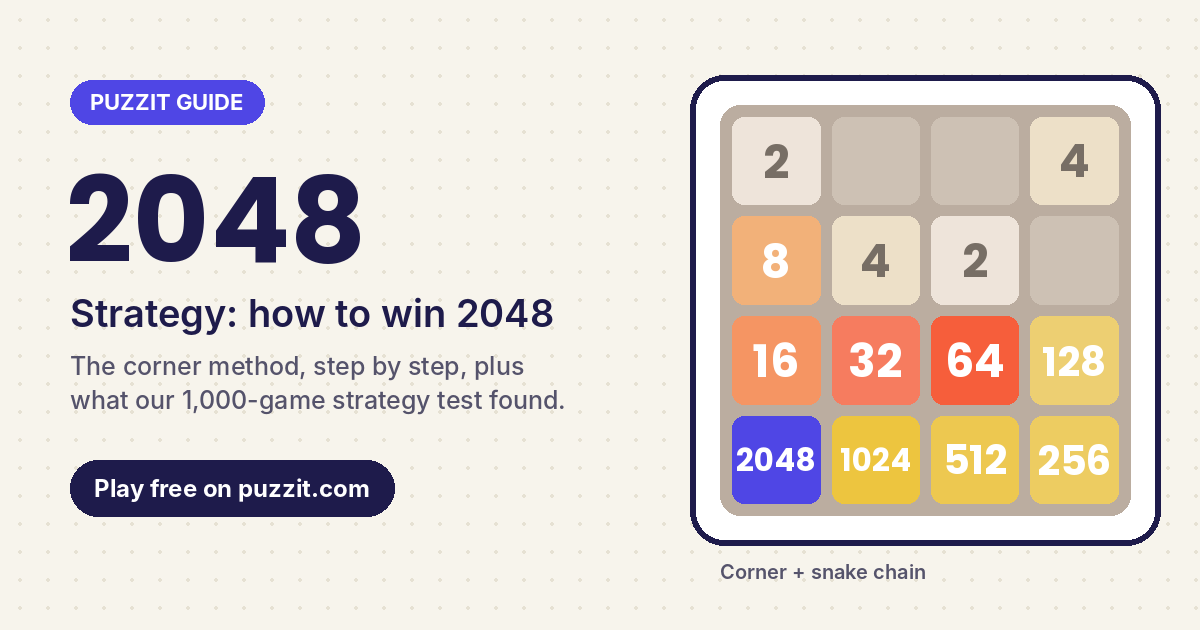
The best 2048 strategy fits in one sentence: park your biggest tile in a corner and build a descending chain of tiles away from it. Almost every guide stops there, though, and players who follow that rule to the letter still get stuck around 256 or 512. To find out why, we ran our own computer test of 2048 strategies over hundreds of simulated games. This guide covers the rules that matter for planning, a step-by-step method for how to win 2048, the one habit that separates a 512 player from a 2048 player, and what to do when the board forces you to press the wrong key. You can practise every tip as you read in the free 2048 game on Puzzit, no download or account needed.
How 2048 works: the rules that shape your strategy
Every move slides all tiles as far as they can go in one direction. Two tiles with the same number that collide merge into their sum, and your score goes up by the value of the new tile. After each move a new tile appears in a random empty cell. In the original game by Gabriele Cirulli, released in March 2014, that new tile is a 2 with 90% probability and a 4 with 10%. The Puzzit 2048 game follows the same classic rules: arrow keys on a computer, swipes on a phone, and a best score that is kept between sessions.
Three details matter more for strategy than they first appear:
- A tile can only merge once per move. A row of 2-2-2-2 swiped left becomes 4-4, not 8. That is why a messy row needs several moves to clean up.
- The total of all tiles only ever goes up by 2 or 4 per move. Merging never creates value; it just packs it into fewer cells. To own a 2048 tile, the game has to hand you 2048 points of tiles first, which is why a win takes roughly 940 moves even with flawless play (a published Markov-chain analysis puts the minimum average at 938.8 moves).
- You lose only when the grid is full and no neighbour pair matches. Space, not score, is the resource you are really managing.
The best 2048 strategy, step by step
This is the corner (or snake) method that strong players use. We describe it with the bottom-left corner, but any corner works if you mirror the directions.
- Choose your corner and commit. Put your largest tile in the bottom-left cell and treat that cell as untouchable.
- Use down and left as your main moves. Right is your third move. Up is the emergency key, and the next sections explain when it is safe.
- Keep the bottom row full. When the bottom row has no gaps, pressing left or right cannot slide your corner tile out of place, so you get more safe moves.
- Build the row in descending order. For example 256, 128, 64, 32 from left to right. Each merge at the small end can then cascade towards the corner.
- Snake upward when the row fills. Continue the chain in the row above, running the other way (right to left), so the smallest tile of the chain always sits next to the next tile it needs to become.
- Merge small tiles early. Stray 2s and 4s that drift behind big tiles get trapped. Clear them while they are still easy to reach.
- Slow down when space runs out. Most moves are obvious; the ones with only two or three empty cells left decide the game.
2048 tips and tricks: think about the next tile
The corner rule keeps your big tile in place, but it does not tell you which of two safe moves is better. That decision is where most games are won or lost. Before you swipe, look at the empty cells the move will leave and ask a simple question: if a 2 lands in each of those cells, can I deal with it?
- Avoid leaving one lonely gap next to big tiles. If the only empty cell after your move sits between a 128 and a 64, a new 2 there may never merge again.
- Prefer moves that keep empty cells together. A cluster of free cells in the top-right area is a workshop where new tiles can meet and merge.
- If you must press up, check the corner column first. When the left column is full and no two equal tiles sit next to each other in it, pressing up cannot move your corner tile. Other tiles in the bottom row may lift, so follow up with down straight away.
- Fix a broken chain immediately. If a small tile lands inside your bottom row, work on merging it before chasing a bigger tile elsewhere.
- Do not chase merges that pull a big tile into the middle. A 512 in the centre of the board blocks four cells around it.
When we played the Puzzit board by mashing down and left with an occasional right and up, the game ended at 1,276 points with a 128 as the top tile. Every key was a "corner" key, but nothing was planned. It is a useful reminder that a direction pattern alone is not a strategy.
Is 2048 luck-based? We tested four strategies
Random tiles mean even perfect play can lose, but how much does skill matter? We wrote a small Python program that follows the exact 2048 rules (4×4 board, 90% 2s, 10% 4s) and let four computer players play. The first three played 1,000 games each; the slower look-ahead player played 200.
| Player | How it chooses a move | Median score | Reached 512 | Reached 2048 |
|---|---|---|---|---|
| Random | Any legal move | 1,052 | 0.2% | 0% |
| Circle trick | Down, left, right, up in turn | 1,042 | 0% | 0% |
| Blind corner | Down if possible, else left, else right, up only when forced | 2,504 | 4.7% | 0% |
| Look-ahead | Tries each move, checks every cell a new 2 or 4 could land in, and its best reply | 35,458 | 99.5% | 76.5% |
The results answer three common questions. The popular "press the keys in a circle" trick is no better than random. Following the corner rule as a reflex more than doubles your score, but it never produced a 1024 tile. The player that kept the same corner preference and simply considered where the next tile could appear reached 2048 in about three games out of four, and 4096 in 27.5%. So 2048 involves luck in every single move, yet across a whole game skill dominates. The habit that matters most is the one in the previous section: think about the new tile before you swipe.
How to win 2048 every time (and why nobody can)
No strategy wins 2048 every time, because occasionally the game drops a tile in exactly the wrong cell when you have no space left. Published research that solved 2048 exactly on smaller boards shows this clearly: even a provably optimal player wins the 3×3 game to 512 only about 74% of the time, and the full 4×4 game to 2048 is too big for anyone to have solved exactly yet. For a human player, a realistic target is to reach 1024 most games, then 2048 regularly. In our test, the games that won took a median of 958 moves and had about 20,224 points at the moment the 2048 tile appeared. If you are past 20,000 points without a 2048, you are on normal pace, not doing anything wrong.
The highest 2048 tile and what comes after 2048
Reaching 2048 does not end the game on Puzzit; you can keep merging for 4096, 8192 and beyond, and your best score is saved. Every tile is a power of two, so each step doubles the work: building a 4096 takes roughly twice as many moves as a 2048. In theory the largest 2048 tile possible on a 4×4 board is 131,072, and it requires the game to hand you a 4 at precisely the right moment. Each new milestone needs the whole snake (one tile of every lower power) lined up in order, which is why the corner discipline matters even more after you win.
2048 vs similar number merge games
Once the 2048 strategy clicks, the same corner habits carry over to other merge puzzles. Here is how the closest games compare:
| Game | Core move | Best for |
|---|---|---|
| 2048 | Slide all tiles; equal numbers merge | Learning the corner and snake method |
| Cupcake 2048 | Same sliding rules with cupcakes instead of numbers | A lighter, cuter version of the same strategy |
| 2248 | Drag a path through equal or doubling numbers | Players who like planning chains rather than swipes |
| High Tile | Merge numbers to push your top tile higher | Short sessions focused on one big tile |
| Threes! | Slide; 1 and 2 make 3, then equal multiples of 3 merge | The mobile game that started the genre |
If you enjoy the cupcake version, our Cupcake 2048 guide walks through that version, and our High Tile article covers how that game plays. For more calm number puzzles, browse the number games hub or read our roundup of number puzzle games.
2048 strategy FAQ
Play 2048 and more free number games
Open a fresh board, pick your corner and try the next-tile check on every move. You will feel the difference within a single game.